
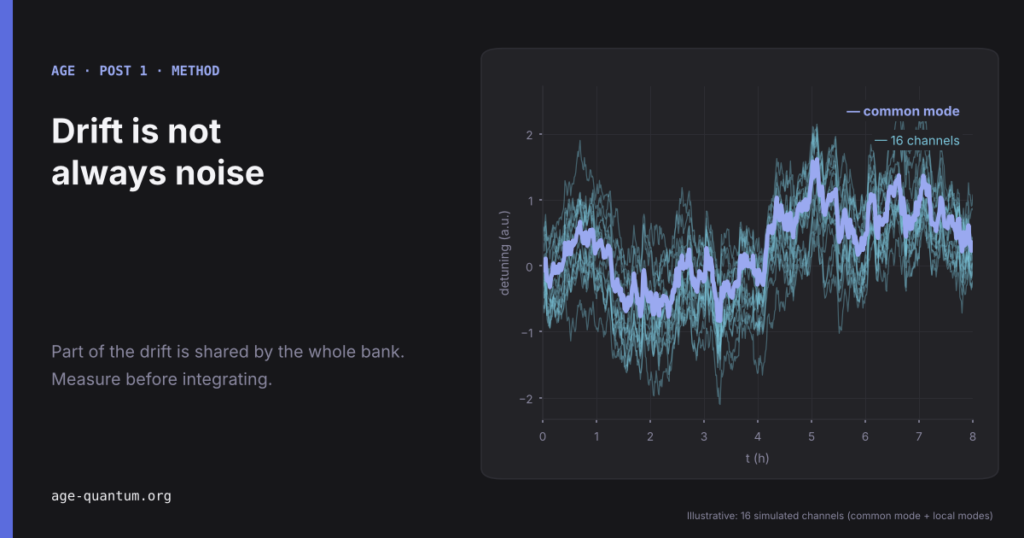
Every microring in a WDM bank shifts with temperature. Standard practice corrects each channel on its own. But devices that share a substrate, package and environment also share part of their dynamics, and that common part is information the controller does not yet use.
A hypothesis you can reject
AGE models the bank as one system: a common mode, local modes and incomplete observation. Every probe of one channel updates the estimate of all of them. The method walks through it step by step. What matters is that the model can fail: if the residuals show no common structure, it is rejected.
What we have measured, and what we have not
In reproducible simulation, joint estimation cuts RMS error by 1.80×. A better single-ring filter gives only 1.06×, and we publish that too. See AGE-PN-001, the benchmark you can run yourself. None of this has been validated on a real chip yet, and every label on Evidence says so.
An open lab, not a catalogue
The Simulator hub holds five free interactive benches, no sign-up. Every figure cites its source:
- LAB 01, interactive photonic circuit: identify and compensate coherent errors in a dual-rail circuit.
- 30 m link test bench: emitting and absorbing temporal modes.
- Minimum norm vs realizability: why algebra alone is not enough.
- Receiver calibration: how much you must measure for the optimal receiver to be real.
- Control budget: the resonator and electronics the receiver needs.
The missing step is yours
A simulation proves nothing about a chip. We are looking for labs to test these predictions on real data, whether they confirm them or refute them. Here is how, with a sealed-forecast protocol.