
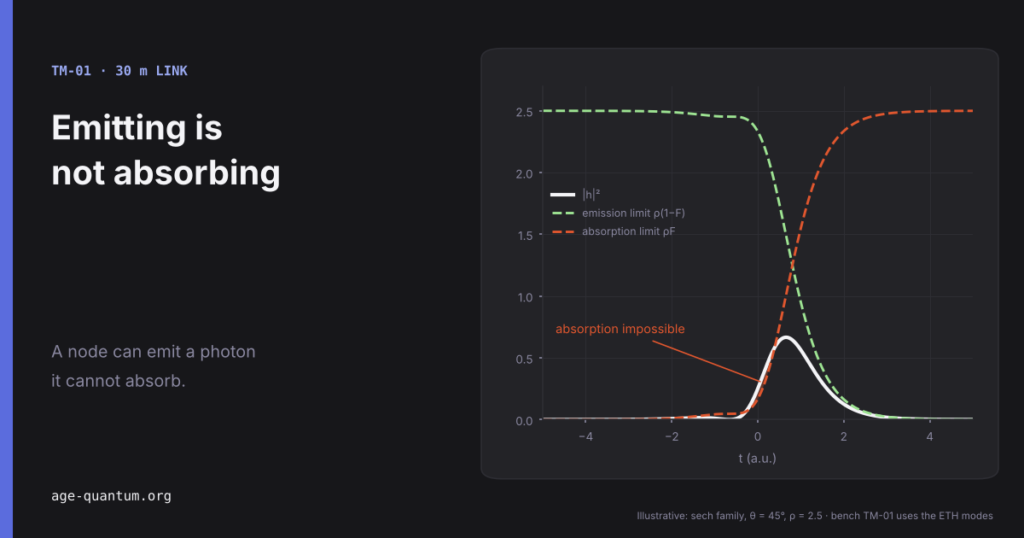
To send a photon from one quantum node to another, the emitter shapes it in time and the receiver must absorb exactly that shape. It looks symmetric. It is not, and the 30 m link test bench shows it in a minute.
Real parameters, not invented ones
The bench uses the published values of ETH Zurich’s transfer experiment (Hernández-Antón et al., arXiv:2604.12947): Γ/2π = 24 MHz, linewidths κ_A/2π = 26.7 MHz and κ_B/2π = 30.7 MHz, a 145.9 ns delay and measured selectivity Σ ≈ 40 (16 dB). Every figure on the bench states whether it comes from the experiment, the AGE manuscript, or our own calculation.
The experiment we suggest
Mix modes f₀ and f₁ at θ = 45° and set the node width to ρ = 1. The node emits the mode but cannot absorb it. Switch to θ = −45° and the opposite happens. The reason is an inequality: emission requires |h|² ≤ ρ(1 − F) and absorption requires |h|² ≤ ρF. Absorbing a mode is emitting its time-reversed version.
Why it matters
A zero-forcing receiver can be perfect on paper and still not executable on the resonator you have. That boundary between algebra and physics runs through every other bench. Next stop: minimum norm vs realizability. The reproduction code is in the software directory, with a DOI.
For experimental groups
If you work with microwave or photonic links, the asymmetries the bench predicts are measurable. Here is how to confirm or refute them.
CTA: Open bench TM-01