
A figure without code is an opinion. That is why technical note AGE-PN-001 ships with everything needed to repeat it: Python code, synthetic data, automated tests and the seed of every run.
What it compares
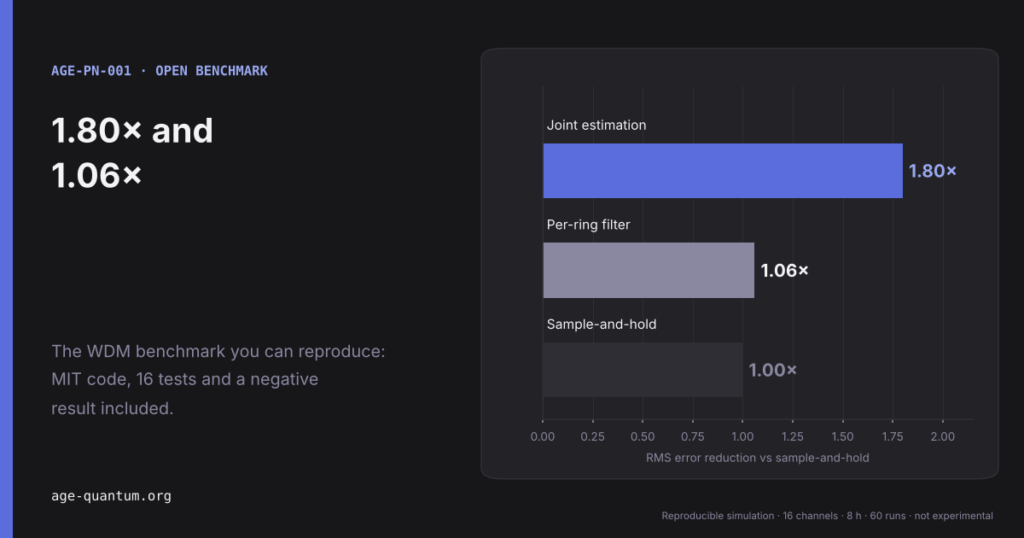
Three strategies on a 16-channel bank under serial monitoring for 8 hours, over 60 runs: sample-and-hold, per-ring estimation, and joint estimation with a common mode plus local modes. The model is described in the method.
The two numbers
- 1.80× lower RMS error with joint estimation in the nominal scenario.
- 1.06× with a better filter on each ring separately.
The second number is the important one. It shows the gain comes from cross-channel information, not from a fancier filter. If someone shows tomorrow that the common mode does not exist on a real chip, the 1.80× disappears, and the benchmark is built to make that visible.
Reproduce it
Download the ZIP from Evidence, create a virtual environment, install the package and run pytest: 16 tests should pass. Then scripts/run_benchmark.py regenerates the figures. The PDF carries its SHA-256 hash so you can confirm it is the same document.
Stated limits
This is a simulation with an explicit nominal scenario, not a measurement. The next milestone is to repeat it on real platform logs, with the scoring segment held out from the fitting segment. If you have those logs, the free evaluation is designed for you.
For the full context, read why we measure before integrating. To try to refute it, start with the sealed-forecast protocol.